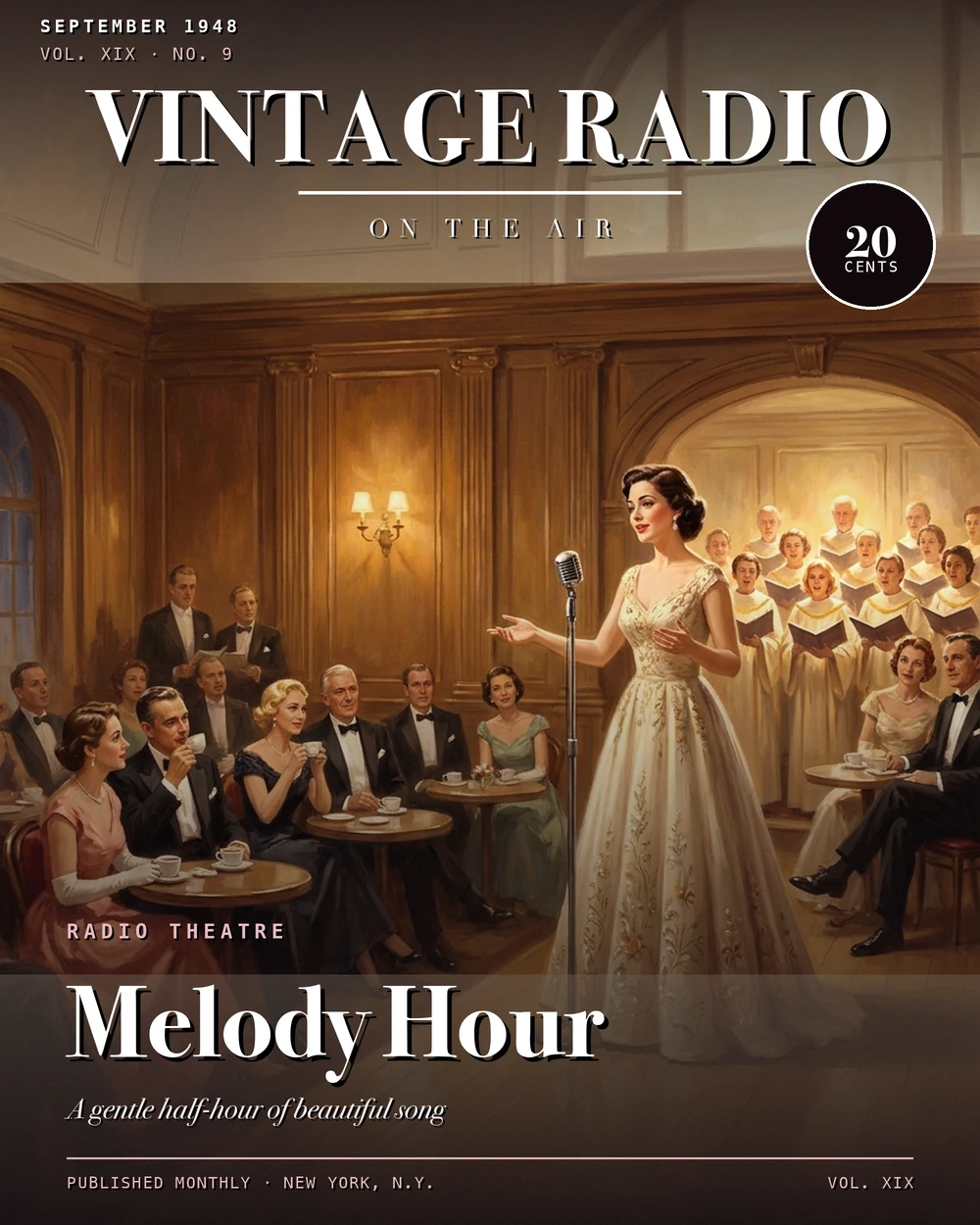
Melody Hour
The Show and What It Was
Melody Hour — broadcast and billed in the trade press under its full title, The American Melody Hour — was a half-hour music program that ran from October 1941 through July 1948, spending its first six months on the Blue Network before moving to CBS, where it stayed for six years. Bayer Aspirin sponsored the show throughout its entire run on both networks, making it one of the more stable commercial arrangements in wartime and postwar radio. The format was straightforward: a half-hour of playing and singing what the program itself described as "the tunes of yesterday and tomorrow," with most of the vocal weight carried by baritone Bob Hannon.
The show was produced by Frank and Anne Hummert, the most prolific production team in radio history. By the 1940s, according to radio historian Jim Cox, the Hummerts controlled 46 percent of the national weekday broadcast schedule and their programs generated more than five million listener letters a year. Melody Hour was one spoke in that enormous wheel — and the title itself was a deliberate echo of the Hummerts' American Album of Familiar Music, which had been running since 1931 and was backed by the same Bayer Aspirin dollar. Both shows leaned on the same blend of operatic, classical, and popular vocal music; the new program was, in effect, a companion piece positioned squarely inside the Hummert musical franchise.
The People Behind the Music
Frank Black conducted the orchestra on The American Melody Hour. Black had become NBC's music director in 1928 and was a fixture in American radio across the 1930s and 1940s, with credits that included The Carnation Contented Hour, Cities Service Concerts, and The Harvest of Stars. In the show's later years, pianist and conductor Victor Arden — born Lewis John Fuiks — stepped in to fill the conductor's role when needed. André Baruch and Larry Elliott shared announcing duties; Baruch had joined CBS around 1930 after reportedly wandering into an announcer audition by accident when he intended to apply as a pianist, and went on to announce for Your Hit Parade, The Shadow, and other Hummert productions. He was inducted into the National Broadcasters Hall of Fame in 1979.
Day-to-day production oversight for the Hummerts' musical programs was delegated to Gus Haenschen, who assigned orchestra leaders, vocalists, arrangers, and announcers across their lineup. At their peak the Hummerts were overseeing as many as 90 episodes per week across all their programs, so the assembly-line approach was a practical necessity.
The Singers
The vocal roster shifted across the show's run but included several names well established in radio and classical music. Soprano Vivian della Chiesa served as both singer and hostess for two seasons. Born in Chicago in 1915 to an Italian family, she trained at the Chicago Musical College and studied with Marion Claire of the Chicago Opera Company as a teenager. In 1935 she won a WBBM singing contest — the prize was a $100-per-week contract for thirteen weekly radio appearances — and the following year she made her Chicago Civic Opera debut as Mimì in Puccini's La Bohème. During the 1940s she was appearing on CBS, NBC, and Mutual simultaneously. Her appearances with the NBC Symphony Orchestra under Arturo Toscanini in January 1943, including a broadcast of Brahms's Ein Deutsches Requiem, are what Opera News calls her best-remembered radio work.
Frank Munn, widely known as "the golden voice of radio," also appeared on the program on both the Blue Network and CBS. Munn's path to radio was unusual: he had been a factory worker who lost part of an index finger in an industrial accident before being discovered as a singer, and he never had formal vocal training. He made his radio debut in 1923, became the lead vocalist for NBC Radio in 1931, and retired in 1945. Throughout his career he sang exclusively on radio and recordings — never in nightclubs, concert halls, or films. He died in 1953.
Conrad Thibault (1903–1987), an American baritone, rounded out the vocal roster alongside Evelyn MacGregor and Eileen Farrell. Thibault grew up in Northampton, Massachusetts — some sources say Northbridge — where former president Calvin Coolidge encouraged him to apply for a scholarship at the Curtis Institute of Music. He graduated from Curtis and then from Juilliard, began his operatic career with the Philadelphia Grand Opera Company in 1928, and by the early 1930s was a regular radio performer on programs including The Maxwell House Showboat and His Master's Voice of the Air. Wikipedia places his documented Melody Hour appearances in 1946–47, though other sources identify him as a regular throughout the show's run.
The Run and How It Ended
On the Blue Network, The American Melody Hour aired Wednesdays at 10 PM, shifting to 9 PM in February 1942 before the network run closed in April of that year. CBS picked it up six days later, on April 21, 1942, where it settled into Tuesdays at 7:30 PM — a slot it held until mid-1947, when it moved to Wednesdays at 8 PM. The CBS run ended on July 7, 1948. No dramatic cancellation story attaches to the ending; the format had simply run its course in a radio landscape that was changing around it.